From Seed Forms to Reconstruction
Toward a Grammar of Civilizational Experimentation

This essay is offered as an homage to the living, moving thought of our dear friend Michel Bauwens.
Not as a conclusion on his work, but as a gesture of gratitude toward a thinker who has spent decades making visible the seeds of another civilization — and who continues to move, refine, deepen, and experiment with his own ideas in service of the commons and of humanity.
The intuition explored here is simple: in the Valley of the Commons, something more ambitious appears than another commons initiative. We may be witnessing the emergence of a strategy of civilizational reconstruction.
Three elements seem especially significant. First, the hubs are no longer imagined as mere coworking spaces, eco-villages, or temporary laboratories, but as “monasteries of the twenty-first century”: places able to preserve, experiment with, and transmit the seeds of a civilization in the making. Second, the discussion moves from discourse to infrastructure: seed forms now need to become permanent arrangements capable of producing livelihoods, hosting people, governing commons, creating revenues, and financing their own development. Third, the word Reconstruction itself matters. It suggests that we may be entering a time in which the task is not only to transform the existing system, but to build, within and alongside its degradation, the institutions capable of surviving it and preparing what may come next.
The recent article on the Valley of the Commons marks this shift with clarity.
For many years, the P2P Foundation has documented an extraordinary abundance of what Michel Bauwens calls seed forms: emerging practices, infrastructures, institutions and modes of coordination that may prefigure another civilization.
This work has made something decisive visible: the future is not absent. It already exists in scattered, fragile, experimental and often marginal forms.
But the present moment asks for another move.
The question is no longer only:
What are the seed forms of the next civilization?
It is becoming:
How do these seed forms become lived, durable and connected experiments of reconstruction?
That shift matters.
It moves the discussion from cataloguing to composition.
From examples to ecologies.
From promising initiatives to living infrastructures.
From peer-to-peer production to peer-for-peer provisioning.
From seed forms to reconstruction.
In Shapership language, it also marks a passage from seeing another possibility to making it visible, desirable and actionable.
1. The shift in scale: from P2P to P4P
The original P2P question was already radical.
It asked how people could produce together outside the exclusive logic of command, ownership and extraction. Peer-to-peer practices showed that knowledge, software, design and culture could be produced by distributed communities of contributors.
This was a profound shift in perception.
It revealed a new productive capacity: people coordinating as peers, sharing knowledge, building commons and creating value outside conventional market and state structures.
But the question has now changed scale.
The Valley of the Commons article introduces a further movement: from peer-to-peer to peer-for-peer.
P2P asks how peers can coordinate and produce together.
P4P asks how communities can produce and provide for one another.
This is not a small linguistic variation. It signals a passage from collaboration to mutual provisioning; from digital commons to territorial commons; from shared knowledge to shared livelihoods; from projects to infrastructures; from networks of contribution to ecosystems of subsistence.
P4P does not cancel the P2P insight. It gives it a body.
The first generation of commons mainly showed how people could share knowledge, software, designs and cultural resources.
The next generation must test whether those capacities can support food, energy, housing, care, tools, livelihoods, governance and continuity.
The question is no longer only:
How do we share knowledge?
It becomes:
How do we build the conditions of life together?
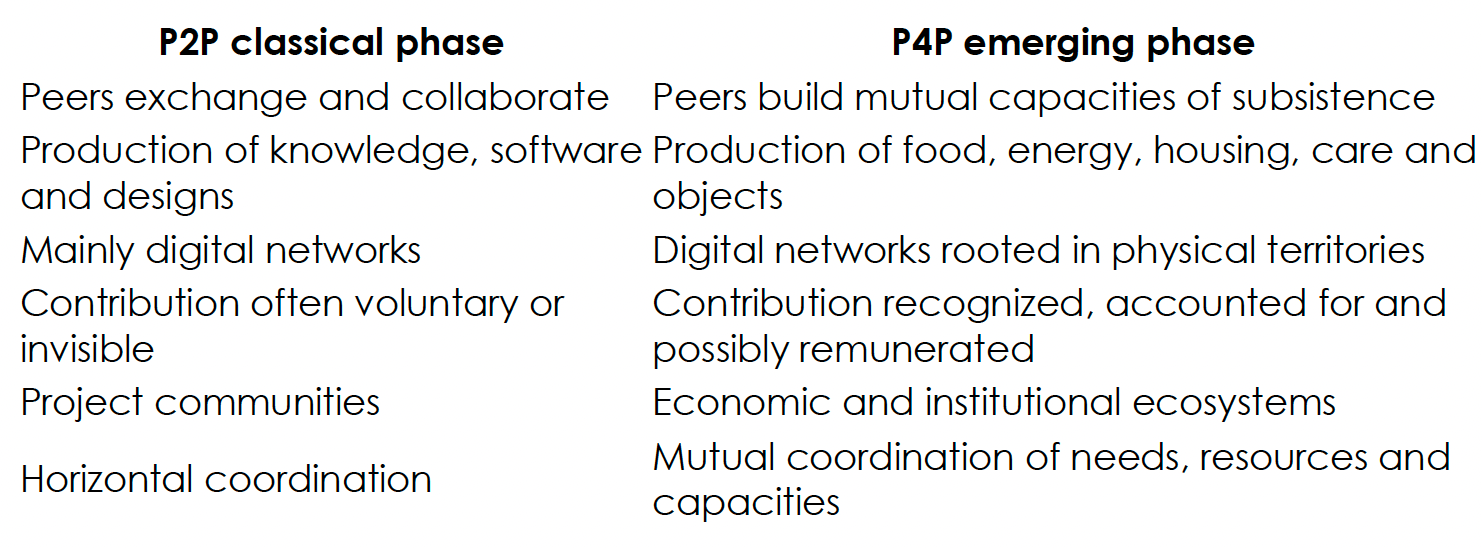
This is why the P4P shift may be understood as the material and institutional maturation of P2P.
P2P made distributed production visible.
P4P asks whether distributed production can become a basis for living together.
2. From seed forms to Reconstruction
The word Reconstruction changes the level of the conversation.
A seed form is not yet a civilization. A collection of seed forms is not yet a world.
A seed form may be brilliant and still remain isolated. It may be replicated and still remain fragile. It may inspire without enduring. It may solve one problem without becoming part of a larger ecology of life.
The Valley of the Commons introduces another ambition.
It is not framed as a conference.
It is not framed as a temporary pilot project.
It is not meant to run for a season and disappear.
It is described as a permanent site of experimentation with commons-centric ways of producing, sharing and accruing value.
The language changes.
We are no longer only speaking about concepts, networks, prototypes or examples.
We are speaking about places.
Commons Hubs.
Co-living.
Fablabs.
Makerspaces.
Regenerative land use.
Shared data ontologies.
Open value accounting.
Governance structures.
Livelihoods.
Community capital.
International networks.
The monastery metaphor becomes crucial here.
After Rome, monasteries preserved books, seeds, crafts, memory and continuity. They were not merely places of retreat. They were institutions of transmission across a period of historical breakdown.
The Commons Hub, the Valley of the Commons and the broader Hubs Network point toward a comparable intuition for our own time: the need for places that can preserve, experiment, transmit and regenerate.
Not as nostalgia.
Not as withdrawal.
Not as a lifestyle enclave.
As reconstruction.
The point is no longer only to identify the seeds of another civilization. The point is to cultivate the conditions under which these seeds may grow, connect, reproduce and endure.
This is the passage from emergence to infrastructure.
From innovation to continuity.
From scattered experiments to ecologies of practice.
From a theory of the commons to an ecology of commons institutions.
3. Why a grammar is needed
An archive of seed forms is not yet a language of reconstruction.
A language needs more than words.
It needs grammar.
By grammar, I do not mean a rigid model or a theory imposed from above. I mean the living principles that allow separate elements to compose.
Grammar tells us how parts relate. It turns isolated signs into speech. It allows meaning to circulate.
The same question now arises for seed forms.
What allows them to compose into something larger than themselves?
Some seed forms concern knowledge.
Some concern production.
Some concern governance.
Some concern care.
Some concern land.
Some concern value.
Some concern finance.
Some concern livelihood.
Some concern coordination.
Some concern transmission.
Some concern the continuity of civilization itself.
Taken separately, each may be powerful.
But reconstruction begins when these functions start to relate.
Knowledge must meet production.
Production must meet livelihood.
Livelihood must meet governance.
Governance must meet value.
Value must meet care.
Care must meet territory.
Territory must meet culture.
Culture must meet transmission.
Transmission must meet institutions capable of surviving historical turbulence.
This is why the next step may not be simply to catalogue more seed forms.
It may be to understand their grammar of composition.
The question becomes:
How do seed forms cease to be isolated initiatives and begin to form lived ecologies of reconstruction?
The Valley of the Commons is interesting because it does not answer this question abstractly.
It tests it.
It places builders, theorists, artisans, organizers, technologies, land, governance and livelihoods in the same field of experience.
It asks whether older patterns of commoning and newer tools of coordination can compose into a life that people can actually live.
That is not only an institutional experiment.
It is a civilizational experiment.
A compact map of the functions to be reconstructed may look like this:
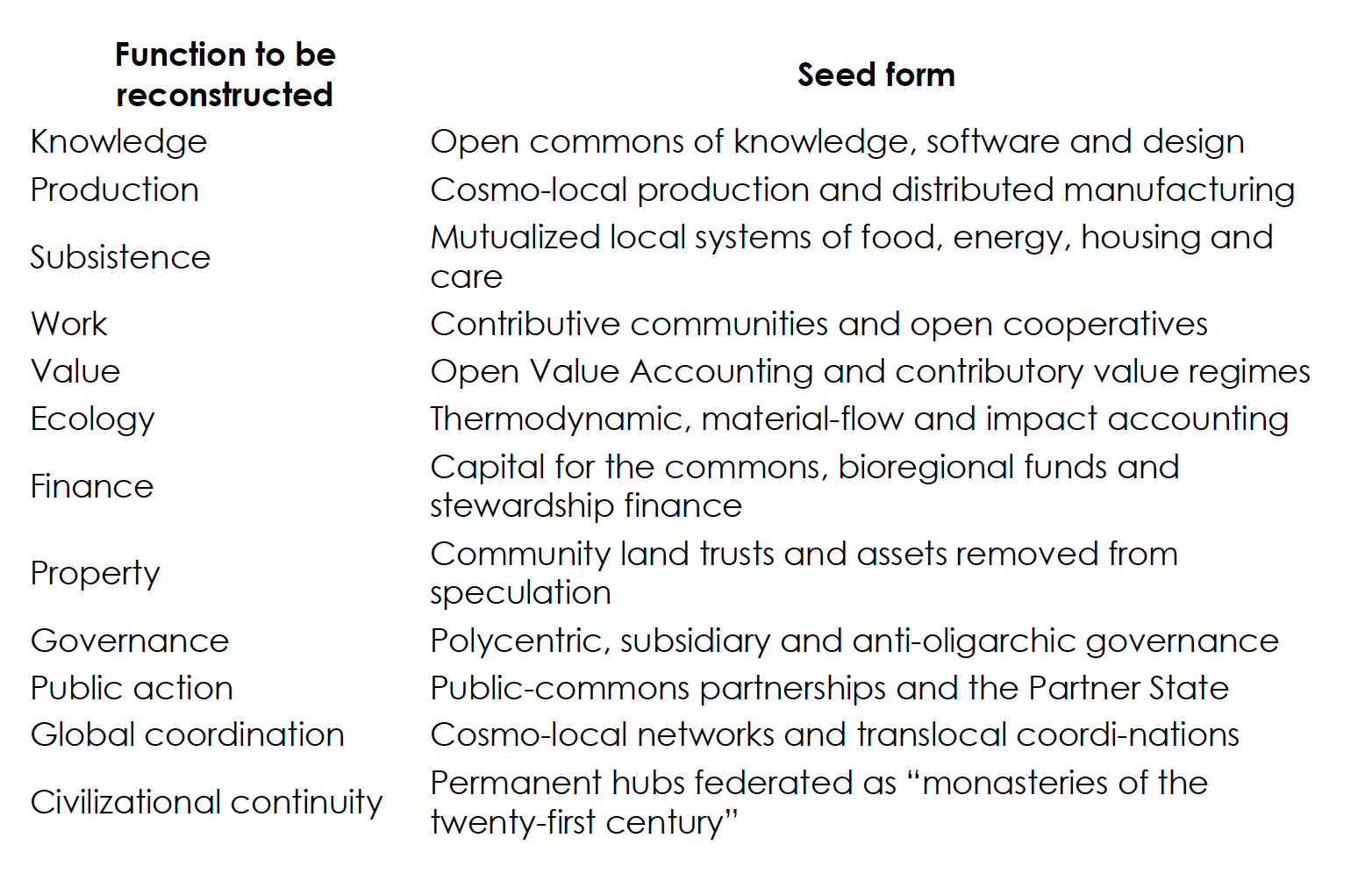
This table should not be read as a complete taxonomy.
It is a first grammar of attention.
It helps us see that reconstruction is not one activity. It is a composition of vital functions.
The Valley becomes significant precisely because it tries to gather several of these functions on one ground: knowledge, production, livelihood, governance, care, culture, finance and translocal coordination.
The challenge is no longer only innovation.
The challenge is composition.
4. Shapership as a grammar of movement
Shapership does not offer another theory of the commons.
Its contribution is not to name more seed forms, but to illuminate the movements through which seed forms may become transformative: the shift in perception, the courage to transgress inherited maps, and the anticipative experimentation of new ways of living and organizing.
Shapership was developed by Aline Frankfort and Jean-Louis Baudoin in The Art of Shapership as an art of re-perception and future-shaping: a way of changing how and what we see so that radically different futures can become visible, desirable, and actionable. A more recent free e-book, The Power and Freedom to Change Our Mental Maps, further clarifies this approach as a work on mental maps, radical imagination, and the passage from MAD Land to NO MAD Land.
It names the movements through which transformation becomes possible.
Shapership begins at the root level of transformation: mental maps. Our mental maps are not the landscape, but they define how we see and shape it.
Transformation does not begin only with new actions, tools, plans or institutions. It begins with the invisible architecture from which these actions become conceivable.
It begins with perception.
With what can be seen.
With what can be wanted.
With what can be shaped.
Shapership is the Art of Re-perception: the power and freedom to change how and what we see, so radically different futures can become visible, desirable and actionable.
It asks us to change maps, not just course.
Its condensed movement is:
SEE.
Make the mental maps visible. Look at reality as it is, above and below the surface. See the boxes, the inherited paradigms, the taken-for-granted assumptions, the old stories that keep us repeating the Same Old Solutions.
TRANSGRESS.
Challenge the dominant map. Resist the status quo. Escape the prison of what is called “realistic” when realism has become obedience to a dying paradigm. Transgress to progress.
REINVENT.
Make radically different and desirable futures visible and actionable. Reinvent organizations, politics, work, life and institutions so that the future we dream of can begin to appear in the present we create.
These three verbs are not an additional method placed next to the DNA of Shapership. They are integrated into it.
SEE belongs to Creative Resistance.
TRANSGRESS belongs to Transformative Vision.
REINVENT belongs to Anticipative Experimentation.
The DNA of Shapership can therefore be read as a living loop:
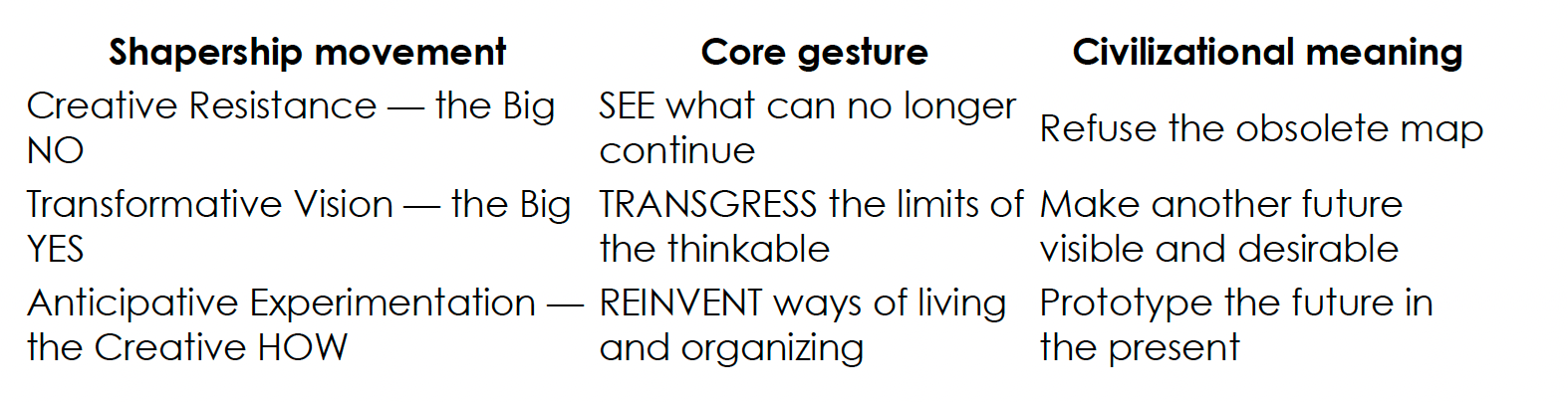
These movements do not form a linear sequence. They must remain alive together.
Creative Resistance without Transformative Vision may become revolt or despair.
Transformative Vision without Anticipative Experimentation remains an awakened dream.
Anticipative Experimentation disconnected from the Big NO and the Big YES loses both its subversive force and its aspirational force.
Together, however, they describe how a new reality begins to take shape.
First, one sees what can no longer continue.
Then, one makes visible what deserves to be born.
Then, one begins to experiment in the present with the forms of the future.
This is why Shapership can illuminate the shift from seed forms to Reconstruction.
It does not add an institutional category.
It names the movement by which institutions become transformative.
5. The Valley as anticipative experimentation

Read through this lens, the Valley of the Commons appears as a powerful case of anticipative experimentation.
Its Big NO is explicit.
The extractive order is reaching its limits. The assumption that forests, rivers, climate and communities can absorb endless abuse is collapsing. The dominant institutions are no longer able to provide dignity, livelihoods, resilience and coherence at the scale of the crises we face.
This is Creative Resistance.
Not protest alone.
Not despair.
A lucid refusal of a world that can no longer sustain life.
Its Big YES is equally clear.
The commons are no longer framed only as historical memories, digital practices or inspiring alternatives. They are presented as possible infrastructures of production, livelihood, governance, care, value and territorial regeneration.
This is Transformative Vision.
A Big YES to commons as a basis for reconstruction.
Then comes the Creative HOW.
The Valley does not offer another manifesto about the world that ought to be. It proposes a patch of ground where people try it and find out.
A Commons Hub.
A month-long popup village.
A fablab.
A makerspace.
Shared land.
Shared books.
Shared governance.
Shared tools of coordination.
Shared experiments in value creation.
A network of hubs.
A path toward permanent co-living and livelihoods.
The aim is not to prove, in theory, that commons-based reconstruction is possible.
The aim is to test it in life.
Builders, theorists, artisans and organizers move into the same field. They run the fablab, work the land, govern themselves, keep books in common and put new coordination tools under real load.
Here Shapership becomes especially relevant.
Anticipative Experimentation is not about making a conventional plan. It is not about correcting the past from inside the same paradigm. It is not about compromise with exhausted logics. It is the bold path of navigating the tension between the world as it is and the future one wants to make real.
To experiment anticipatively is to act with a radically different future in mind.
It means opening a transition path from one pattern of activity to a radically more desirable one.
It means learning by doing.
It means reinventing the way things operate.
Life reinvented.
Work reinvented.
Power reinvented.
Strategy reinvented.
Production reinvented.
Governance reinvented.
Livelihood reinvented.
Because systems issues require systems solutions, anticipative experimentation is necessarily ecosystemic. It does not act alone. It builds coalitions of actors, partners, contributors and complementors. It creates work-nets more than social networks: communities of commitment organized around a purpose rather than around a guru.
In the Valley, this takes concrete form.
The fablab is not only a technical workshop. It becomes a place where local needs meet shared designs and emerging technologies.
The co-living is not only housing. It becomes the threshold condition for a permanent community.
The governance work is not only internal coordination. It becomes a test of subsidiary, lean, open and fault-tolerant institutional design.
The storytelling is not only communication. It becomes working capital, opening doors, attracting the right people and building legitimacy.
The investment vehicles are not only financial instruments. They become a way to move capital toward regeneration and prevent the commons from becoming a lifestyle for the few.
The international network is not only a friendly federation. It becomes an attempt to move toward hubs coordinated tightly enough to carry transformation across distance.
In this sense, the Valley is not only a site.
It is a gesture.
It says:
If the future is not guaranteed, it must be prototyped.
If commons are to become more than inspiring examples, they must become livable arrangements.
If reconstruction is to be real, it must touch land, work, governance, culture, care, money, value and daily life.
This is the passage from interpretation to experimentation.
And perhaps from experimentation to reconstruction.
6. The living dynamics: toward a morphogenesis of reconstruction
The Valley of the Commons does not yet answer all the questions it raises.
Nor should it.
Its value lies in refusing premature closure.
It opens a field of inquiry:
How do seed forms support one another?
How do they compose?
How do they protect themselves from capture?
How do they remain open without dissolving?
How do they become economically viable without becoming extractive?
How do they transmit knowledge, culture and practices across generations?
How do they federate without centralizing?
How do they become institutions without losing their soul?
These questions point toward a possible morphogenesis of reconstruction.
Not a theory imposed before practice.
An emerging understanding of how forms become living systems.
At this point, another element of Shapership becomes useful: the 6L.
The 6L were created by Jean-Louis Baudoin as an everyday philosophy — a simple, living grammar for inhabiting the world with more attention, freedom, joy, and depth. In the context of this article, they are not presented as a theory of institutions, but as living dynamics that may help us sense whether an ecology of seed forms is truly becoming alive.
LOOK
Every transformation begins with perception. A civilization changes when people see something that was previously invisible. Seed forms emerge because someone notices possibilities hidden inside reality.
LISTEN
Once multiple seed forms exist, they must learn from one another. Listening creates mutual learning. Without listening, every innovation remains isolated. Networks emerge from listening.
LEARN
Learning allows adaptation. Seed forms copied mechanically become formulas. Seed forms that learn can survive changing conditions. Learning is evolution made conscious.
LAUGH
Every institution risks becoming rigid. Humour, play and serious experimentation soften the walls. Without play, institutions fossilize. The future requires places where trial, error and imagination are allowed.
LOVE
Commons are sustained less by mechanisms alone than by care, trust and commitment. People protect what they love. Without love, governance becomes procedure; with love, stewardship becomes possible.
LIVE
All ideas return to life. Can people live here? Work here? Grow food? Produce tools? Raise children? Grow old? Care for one another? If not, the seed remains an experiment. Living is the ultimate validation.
The 6L bring the grammar back to life.
They remind us that reconstruction is not only institutional design. It is also perception, listening, learning, play, commitment and lived embodiment.
Seed forms tell us what may emerge.
P4P asks how these forms may provide for life.
Reconstruction asks where they may take root and how they may endure.
Shapership names the movement: see what can no longer continue, transgress the limits of the inherited map, reinvent the ways of living and organizing that make another future actionable.
Perhaps the next civilizational task is not only to multiply seed forms.
It is to learn how they compose.
To discover the grammar through which scattered initiatives become living ecologies.
To create places where this grammar can be tested.
To build networks where it can be shared.
To cultivate institutions capable of preserving knowledge, generating livelihoods, governing shared resources and transmitting hope across a time of breakdown.
The old order is waning.
The new one is not guaranteed.
It is a potential, not a prophecy.
But a potential becomes real when people begin to act from it.
This may be the deeper meaning of Reconstruction.
Not the restoration of what was.
Not the management of decline.
Not another manifesto.
The anticipative experimentation of what may become.
A new civilization does not begin only as a theory.
It begins when another way of seeing becomes another way of living.
Thank you, Michel, for having held this vision for so long, for having given language, dignity, and coherence to so many emerging forms, and for continuing to help us see that another civilization is not only desirable, but already trying to be born
Source note
Shapership is a concept and practice developed by Aline Frankfort and Jean-Louis Baudoin and presented in The Art of Shapership: The Eye Only Sees What the Brain Is Ready to Understand (2023). The Shapership concepts used in this essay — the Art of Re-perception, mental maps, Creative Resistance, Transformative Vision, Anticipative Experimentation, MAD Land / NO MAD Land, and the power to make radically different futures visible, desirable, and actionable — are further developed in Aline Frankfort’s free e-book The Power and Freedom to Change Our Mental Maps. The 6L were created by Jean-Louis Baudoin as an everyday philosophy and later integrated into the broader Shapership universe as a simple grammar of living: Look, Listen, Learn, Laugh, Love, Live.
The Valley of the Commons, Michel’s Substack: Fourth Generation Civilisation
The Art of Shapership (2023), ebook , https://payhip.com/b/0qoRO
The Power and Freedom to change our mental maps (2026). Free e book
the 6Ls as an enriching way to inhabit the world, (2024°, free ebook
The shapership call , substack free articles